
 If you’ve been through MITAGS’ Navigation Skills Assessment Program (NSAP®)™ and/or have sat in a classroom with MITAGS’ Instructor and Lead NSAP® Assessor, Captain Jerry Hasselbach, odds are you’ve seen him present on or discuss the Doubt Signal.
Captain Hasselbach has had the ability over the last several years to witness and assess over 1000 NSAP® sessions. During these sessions, Captain Hasselbach has gained more knowledge and lessons learned than he could have originally imagined, leading to what has developed into a presentation on the Doubt Signal.
In his presentation, he shares one of the most frequently misunderstood situations that is covered under the ColRegs. The situation being referenced is the simple situation of having another vessel crossing from one’s port side, and one’s status and resultant duties under the ColRegs changing several times as one’s mental state changes.
Captain Hasselbach has put his Doubt Signal presentation into written form to share it with the maritime community in hopes that the outcome will be better understood by all mariners and be taught in maritime schools around the world. . Click the button below to read this article.
To speak to someone at MITAGS about the NSAP®, contact us here.
Related Posts

MITAGS recognized as a leader in research simulation
MITAGS’ simulation partner Wärtsila has posted an article on its web site describing the growing role of simulation in port development and ship design. The article highlights MITAGS’ role as not just a pioneer in the use of simulators, but an industry leader in application of new technologies and capabilities. It mentions one notable project […]
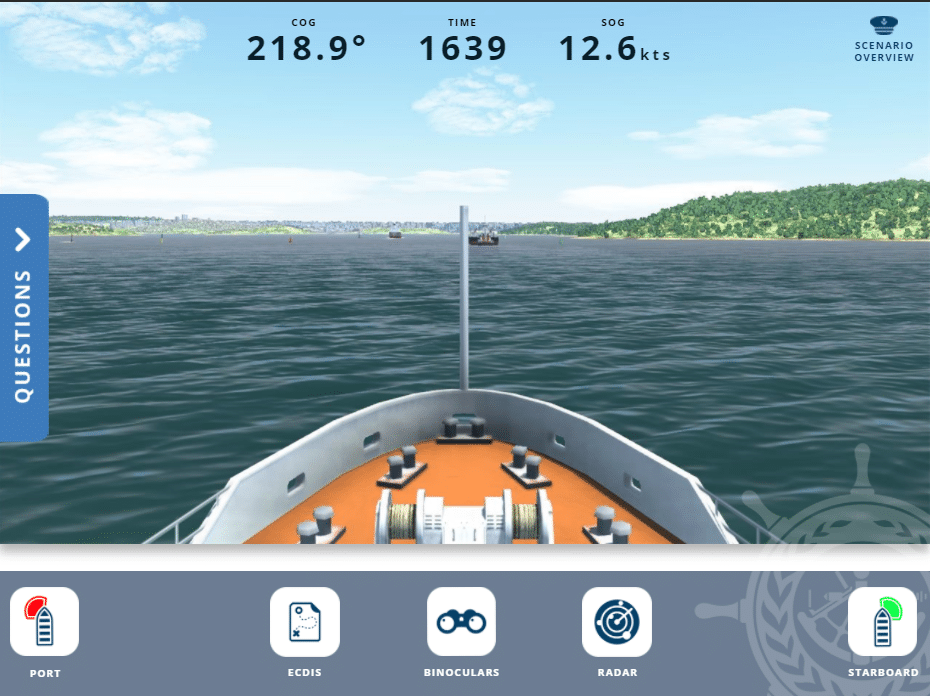
MITAGS launches NAV-SAFE Digital Voyages
MITAGS is starting the new year with the introduction of an exciting new type of training and assessment tool. NAV-SAFE Digital Voyages combine the interaction of a video game with the science of skills assessment. NAV-SAFE is a digital learning product which can be loaded onto a company's Learning Management System (LMS), or accessed via the internet. This means mariners can access the product while working at sea or from home on their time off, without having to travel to a distant training center. NAV-SAFE uses technology drawn from MITAGS's powerful Wärtsilä bridge simulators combined with a polished learning experience developed in association with UK-based KILO Solutions. Participants in a Digital Voyage navigate a ship through a challenging series of interactions with other ships, navigational hazards and weather activity. They make decisions based not only on visual information, but interpretation of data from Radar and ECDIS, and voice communications over VHF radio with other ships, traffic control and their own lookouts.

ROM Quarantine and Military Sealift Command
Close-quarters ships are no place for a fast-spreading virus. You can imagine how quickly diseases move when a large group of people is gathered in one place for a long time. To prevent this scenario from playing out, the United States Navy, and, more specifically, the Military Sealift Command, can impose a Restriction of Movement […]